
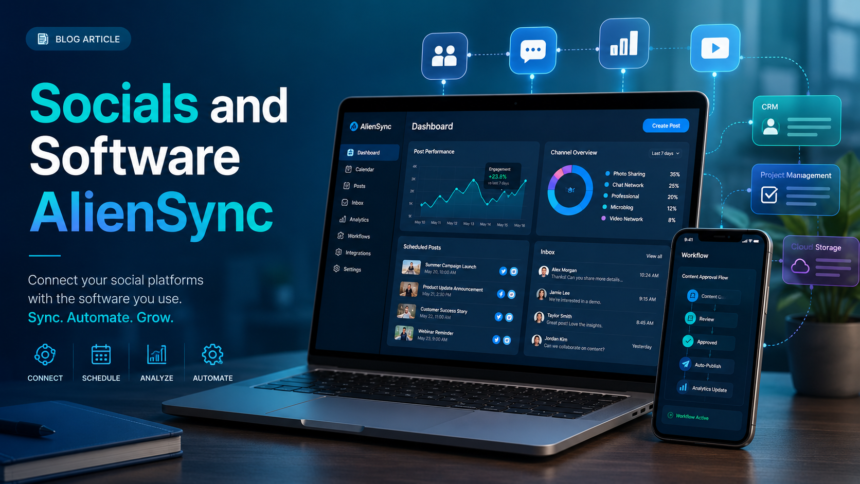
Managing several social accounts and digital tools can become messy surprisingly quickly. A business may use one platform for publishing, another for analytics, separate apps for communication, and more software for planning everyday work. Socials and Software AlienSync is a term connected with AlienSync’s approach to bringing these parts of digital work closer together.
There is an important detail worth understanding from the beginning. AlienSync.com presents itself broadly as a technology website covering apps, social media, software, blockchain, crypto, and emerging technology. At the same time, a growing collection of pages on the site describes AlienSync as a system for connecting social accounts, applications, communication, publishing, and workflows.
Because of that mixed positioning, it is better to look at Socials and Software AlienSync as an integration and digital-management concept described by AlienSync, rather than assuming every feature mentioned around the web has been independently verified.
What Is Socials and Software AlienSync?
Socials and Software AlienSync refers to the idea of managing social media activity and connected software from a more unified environment.
AlienSync describes its social system as a cross-platform setup intended to bring profiles, posts, communication, analytics, and application events into a central interface. Its own material says the approach is designed for people such as creators, marketers, social media managers, agencies, and smaller teams managing activity across several online services.
The basic idea is easy to understand. Instead of constantly moving between several dashboards, a connected system attempts to keep important digital activities closer together.
That could include content planning, publishing, account management, performance measurement, communication, or software-triggered workflows.
Why AlienSync Can Be Confusing
Searching for AlienSync can produce different explanations of what the name represents.
The official AlienSync website describes itself as a technology destination with categories including Apps – Socials & Software, blockchain and crypto, social media, gaming, and general technology coverage. Its About page similarly describes AlienSync as a technology-focused hub with editors covering software and digital experiences.
However, AlienSync has also published articles describing an AlienSync app or synchronization system capable of connecting social platforms and other applications. One recent feature description calls it a cross-platform social and app-integration system.
For readers researching the keyword socials and software AlienSync, this distinction matters. Feature descriptions found in AlienSync articles should be treated as statements from the site itself unless they can also be confirmed through product documentation, app-store listings, technical documentation, or supported third-party integrations.
The Social Side
The social-media part of AlienSync’s described approach centers on reducing the amount of repetitive work involved in managing several accounts.
A social manager may otherwise need to prepare content, open each network separately, upload media, rewrite captions, check comments, record results, and repeat much of the same process several times.
A centralized platform can potentially reduce some of that work when social networks provide the necessary APIs and permissions.
This type of integration is technically possible on major networks. TikTok, for example, maintains an official Content Posting API that lets approved applications send content directly to authorized TikTok profiles or upload drafts for users to finish inside TikTok.
LinkedIn likewise provides a Posts API for creating and retrieving supported forms of organic and sponsored content.
So the broader principle behind AlienSync’s social-management idea is well established, even though the exact level of AlienSync’s individual platform support should be checked directly before relying on it.
The Software Side
Social publishing is only one part of the concept. Software synchronization is meant to connect information or actions between separate digital tools.
A business might want a task created when something happens in another system. A marketing team may want social activity linked with reporting tools. A project manager might prefer notifications and task updates to appear without manually copying information between applications.
AlienSync describes this side of its platform as a way of reducing disconnected workflows and unnecessary app switching. Its material refers to customizable workflows, data synchronization, dashboards, and connections between business applications.
In practical terms, useful software integration normally depends on APIs, webhooks, authentication systems, and permissions supplied by the applications being connected.
That means integration quality matters more than the number of logos displayed on a product page.
Cross-Platform Publishing
One of the most attractive ideas behind Socials and Software AlienSync is preparing content once and distributing it across several channels.
This can save time, but good cross-platform publishing should not mean blindly posting exactly the same material everywhere.
Every social network has its own formats, audience expectations, technical requirements, and publishing permissions. A professional LinkedIn post may need different wording from a TikTok caption, while a video prepared for one network may require different dimensions or metadata elsewhere.
Official developer systems also impose their own rules. TikTok requires developer registration, appropriate publishing scopes, user authorization, and, for unrestricted direct posting, an audit of the API client.
A good synchronization tool therefore needs to respect each network’s rules rather than simply copying content from one place to another.
Centralized Workflows
The strongest reason to consider an integrated system is usually not convenience alone. It is workflow consistency.
When marketing activity is spread across too many apps, small tasks are easy to miss. Someone may forget to publish a post, respond to a message, update a campaign status, or send information to another member of the team.
A central workflow can create a clearer view of what has been completed and what still needs attention.
For smaller businesses and creators, reducing unnecessary app switching can also make daily work feel less fragmented. Instead of remembering several separate processes, teams can follow a more consistent routine.
That is the practical appeal behind the Socials and Software AlienSync concept.
Analytics and Engagement
Publishing content is only useful when organizations can understand what happens afterward.
AlienSync’s published descriptions refer to analytics, engagement tracking, social listening, reporting, and centralized performance information.
Again, the amount of data a third-party platform can access depends partly on what each social network makes available through its APIs.
LinkedIn, for example, has dedicated APIs for social metadata, reactions, and comments, although access and permissions vary depending on the use case and account authorization.
The most useful analytics dashboard is not necessarily the one displaying the greatest number of charts. It is the one that helps a user answer practical questions: Which content is working? Where is engagement coming from? What should change next?
Security and Permissions
Connecting several accounts to one service deserves careful attention because integration tools may require permission to access content or perform actions on a user’s behalf.
Users should understand exactly what permissions they are granting.
Major platforms generally use authorization scopes to control this access. TikTok’s publishing documentation, for example, requires an authorized access token and specific scopes before a third-party application can publish or upload content for a user.
LinkedIn also separates permissions for actions such as posting or retrieving organizational content.
Meta’s Instagram developer platform similarly distinguishes professional account functionality and content-publishing access through its platform APIs.
Before connecting sensitive business accounts to AlienSync—or any similar service—review its current privacy policy, account-permission screens, data-retention practices, authentication options, and method for removing integrations.
Benefits of a Connected Setup
A properly implemented social and software management system can have several practical advantages.
The biggest is less repetitive work. Publishing, monitoring, reporting, and internal coordination can take considerable time when every step happens separately.
Another benefit is consistency. Centralized access can make it easier to keep brand information, scheduled content, campaign plans, and team responsibilities organized.
There is also a collaboration advantage. When several people contribute to marketing, a shared system can provide clearer ownership than passing links, screenshots, passwords, and spreadsheets between team members.
The real value, however, depends on whether the integrations a particular organization actually needs are supported reliably.
Limits to Consider
No social-management platform can remove every limitation created by the networks it connects to.
Social platforms regularly change API rules, permission requirements, content formats, rate limits, and available features. An action that works through a network’s native application may not always be available to third-party software.
TikTok’s developer documentation illustrates this clearly. Publishing integrations require specific authorization, while unaudited clients face restrictions on content visibility.
The same principle applies across the industry: third-party tools depend on access granted by the original platform.
Users should therefore avoid assuming that a single dashboard will reproduce every native Facebook, Instagram, TikTok, LinkedIn, or X feature.
Who Could Use AlienSync?
The Socials and Software AlienSync idea is most relevant to people who regularly work across several digital channels.
A content creator managing multiple profiles may value centralized planning. A small business could benefit from reducing repetitive posting and reporting. Marketing agencies have an even stronger reason to centralize work because they frequently manage several brands and client accounts.
Remote teams may also find connected workflows useful when responsibilities are divided between content writers, designers, account managers, and analysts.
For someone managing only one social account occasionally, however, a large integration system may add more complexity than it removes.
How to Evaluate AlienSync
Before adopting any platform, evaluate it according to your actual workflow rather than its longest feature list.
Start with the services you use every week. Check whether the current AlienSync product provides documented integrations for those exact services and whether publishing, messaging, analytics, or automation features work at the level you need.
Then examine permissions. Find out what information the platform can read, what actions it can perform, how access is removed, and whether team members can receive separate roles instead of sharing account credentials.
Finally, test the daily workflow. A platform designed to save time should genuinely reduce the number of steps needed to complete routine work.
Convenience is valuable only when reliability, security, and control remain intact.
AlienSync and Regular Social Schedulers
Traditional social schedulers primarily concentrate on preparing and publishing posts. More advanced systems add inboxes, analytics, collaboration, approvals, and social listening.
The broader Socials and Software AlienSync concept goes beyond scheduling by presenting social accounts and software applications as parts of the same connected workflow. AlienSync’s own descriptions emphasize this combination of social profiles, application events, communication, and automation.
Whether that approach offers an advantage depends on how deeply its integrations work in practice.
A business that only needs scheduled posts may prefer a focused publishing tool. A team trying to connect marketing with several other applications may gain more from an integration-oriented system.
Better Ways to Use Social Software
Centralization should not encourage careless automation.
Content still needs human judgment. Posts should match the audience and culture of each platform. Automated responses need oversight, particularly when dealing with complaints or sensitive customer issues.
Teams should also periodically review old integrations. Applications that no longer need account access should be disconnected rather than left authorized indefinitely.
The healthiest approach is to automate repetitive steps while keeping strategy, brand judgment, customer conversations, and final accountability in human hands.
What the Future Could Look Like
Social and software tools are moving toward deeper integration because businesses increasingly operate across many cloud services at once.
Official developer platforms already make cross-platform publishing and social-data integrations possible in controlled ways. TikTok supports direct posting and draft uploads through its developer platform, while LinkedIn provides APIs for posts and social interactions.
For platforms such as AlienSync, the long-term challenge will not simply be adding more connections. It will be maintaining dependable integrations while social networks continually change their policies and technical requirements.
Users are likely to value tools that offer clear permissions, reliable synchronization, useful analytics, flexible workflows, and straightforward account control.
Final Thoughts
Socials and Software AlienSync reflects a useful idea: bringing social-media management and connected software into a more organized workflow.
AlienSync currently presents substantial material around centralized social profiles, application integration, publishing, communication, analytics, and workflow automation. At the same time, its wider website also operates as a technology-content hub, so readers should distinguish published descriptions from independently verified product capabilities.
For businesses, marketers, creators, and agencies, the concept can make sense when multiple platforms are becoming difficult to manage separately. The deciding factors should be practical ones: Does it support the tools you use? Are the integrations reliable? Are permissions transparent? Does it genuinely save time?
Those questions provide a much better measure of value than feature claims alone.
FAQs
What is Socials and Software AlienSync?
Socials and Software AlienSync is a term used around AlienSync’s approach to connecting social-media activity with software and digital workflows. AlienSync describes features involving centralized profiles, publishing, communication, analytics, and app integration.
Is AlienSync a social media management tool?
AlienSync publishes material describing a social and app-management system, but AlienSync.com also identifies itself as a wider technology-content hub. Users should therefore verify the current product, supported integrations, and available features directly before making a purchasing or implementation decision.
Can AlienSync publish to different social networks?
AlienSync says its system supports cross-platform social workflows. The precise networks and functions currently available should be confirmed through AlienSync’s up-to-date documentation. Technically, networks such as TikTok and LinkedIn provide APIs that allow approved third-party applications to publish content under defined permissions.
Is Socials and Software AlienSync safe?
Safety depends on the implementation, permissions requested, authentication methods, data-handling practices, and the accounts being connected. Users should review AlienSync’s current privacy information and carefully inspect every authorization request before granting access.
Who should use Socials and Software AlienSync?
The concept is most suitable for marketers, content creators, agencies, small businesses, social managers, and teams dealing with multiple accounts or applications. People managing only one account may not need such a broad system.
Does AlienSync replace individual social media apps?
Not completely. Third-party management tools depend on the APIs and permissions supplied by individual social networks. Some native features may therefore remain available only inside the original social-media application.
Why are social software integrations useful?
They can reduce repetitive tasks, centralize information, improve coordination, and make cross-channel reporting easier. Their value is highest when the connected services match a team’s actual daily workflow.
What should I check before using AlienSync?
Check its currently supported social networks and software integrations, requested permissions, privacy and security controls, account-removal process, collaboration options, analytics coverage, reliability, and current pricing or subscription terms before committing.
Read also BeaconSoft Tips for Tech: Easy, Safe Computer Advice